When people think of Syria today, they think of rich history, ancient ruins, and stunning landscapes.
With treasures like the Old City of Damascus, the Aleppo Citadel, and the ancient ruins of Palmyra, each site tells a story that spans thousands of years.
Syria is a captivating destination for travelers looking to dive into its cultural depth.
However, beyond these remarkable sites lies a more recent chapter that has profoundly transformed the country and has significantly influenced its modern identity.
The Syrian Revolution, one of the most pivotal moments in the country, began in 2011 in the southern city of Daraa.
The Boy Who Started a Movement
In March 2011, in the southern city of Daraa, inspired by the Arab Spring sweeping across the region, a boy called Muawiya Siyasneh and his classmates, who were around 15 years old at the time, made a bold statement that would resonate throughout Syria.
They spray-painted a simple yet powerful message on a school wall: “Your turn, Doctor (addressing Bashar al-Assad), and Freedom“.
This act by teenagers became the spark that ignited nationwide protests.
These simple words, scrawled by young students like simple graffiti, sparked widespread protests across Syria and led to events that reshaped the country’s political and social fabric.
A Harsh Response That Ignited Anger
Instead of addressing the children’s concerns, the government of al-Assad responded with brutality—arresting and torturing the boys for 45 days.
The Assad government tortured them using electrical shocks through water, beatings with cables, and the “ghost” method—where the boys were suspended by their hands until they lost strength.
In Syrian culture, as anywhere in the world, harming children is deeply unacceptable, and this cruelty shocked the entire community.
The people of Daraa demanded an official apology, but the government refused to apologize and refused to release Siyasneh and his friends.
This led their families to protest and demand their freedom. The Assad government reportedly told their parents, “Forget your children.” In response, the regime confronted the demonstrators with live bullets, which then sparked protests in Daraa, Homs, Damascus, Hama, and almost all over Syria.
When mentioning Daraa, one cannot ignore the child dubbed the “icon of the revolution.” Hamza al-Khatib died under torture at the hands of the Assad regime.
His body was mutilated and burned after being arrested in rural Daraa in late April 2011.
This boy became a symbol of courage and sacrifice in Syria.
From Protest to Revolution
The refusal to apologize fueled outrage, leading to mass demonstrations calling for reforms.
When the government failed to implement changes, the demands escalated to calls for the end of the Assad regime.
This marked the start of the Syrian revolution—a movement that would last for years and forever change the country’s history.
From the local graffiti incident to the revolution calling for freedom, dignity, and reform, these actions embraced the whole nation because every Syrian citizen mattered.
Syria’s Long-Awaited Liberation
After years of sacrifice and loss, the Syrian people finally saw the day they had long dreamed of on the 8th of December, 2024.
The fall of the Assad regime marked the end of decades of fear and oppression.
The same streets that were once silenced by violence were now filled with the sounds of celebrations as Syrians experienced a new era of freedom and hope.
This “great victory” was what all Syrians had been waiting for years.
Because of the Assad regime, the people had suffered from killings, suppression of freedoms, and the consequences of a collapsing economy.
Now, the victory belonged to every voice that had spoken out, every family that had endured hardship, and every life that was given the dream of a free Syria.
Today, the young man Muawiya Siyasneh from Daraa expresses no regret; he sees it as liberation from the Assad family’s rule, which lasted more than half a century.
Fate placed him and his schoolmates at the center of Syria’s change.
Recent interviews and documentaries highlight the long legal battle faced by the students.
It is reported that Muawiya al-Siyasneh waited nearly 15 years for justice, attending hearings related to his initial detention. His perseverance stands as a testament to the resilience of the Syrian youth who started this journey.
The Changing of the Syrian Flag
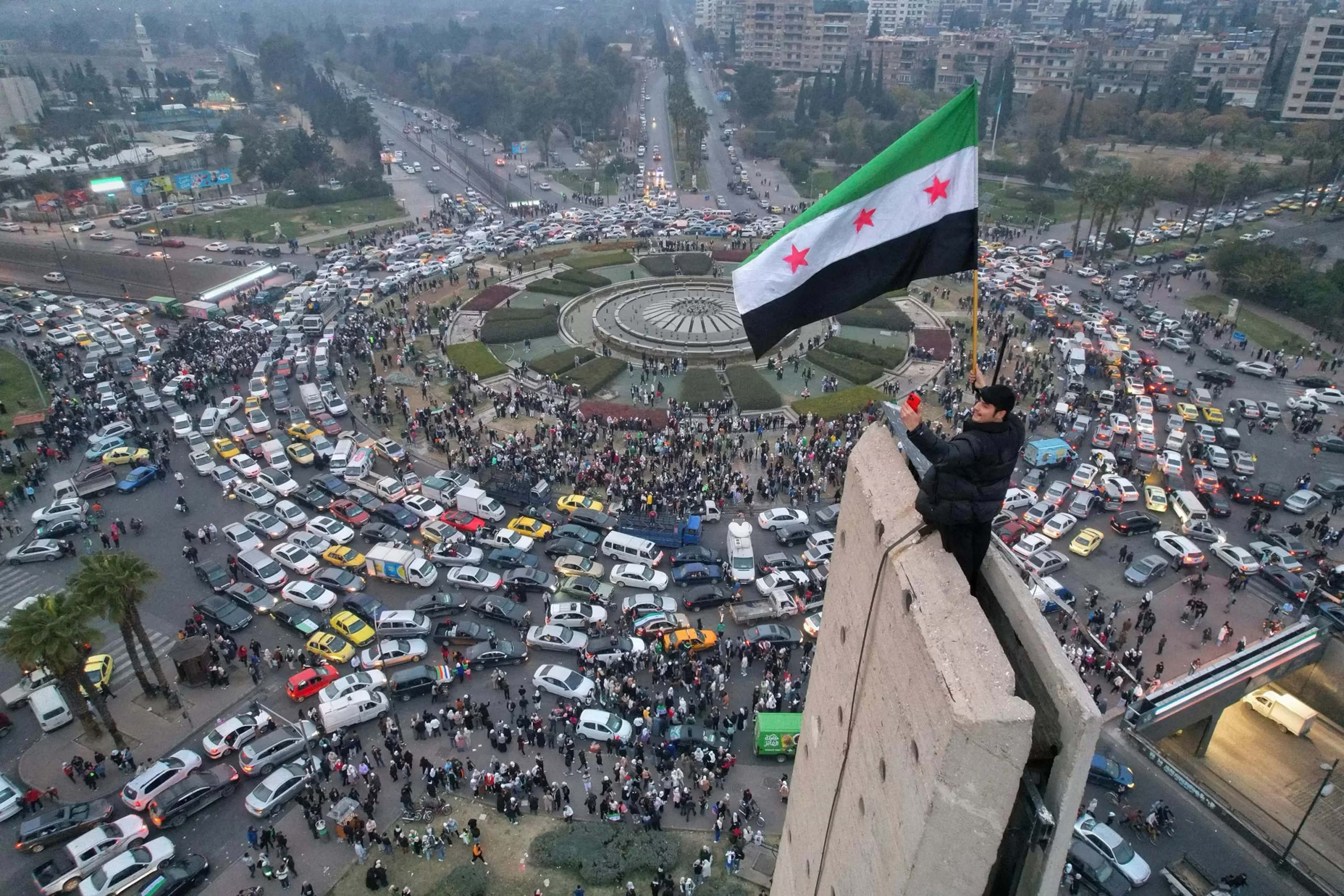
During the Syrian revolution, the flag became a powerful symbol of change.
The opposition adopted a new flag—green, white, and black with three red stars— as a design linked to Syria’s independence era and in contrast to the official red, white, and black flag of the Assad government.
The Syrian flag, a symbol of freedom, has a long history, from the Arab Revolt of 1916 to the Great Syrian Revolt in 1925, and finally the 2011 revolution.
Revolutionaries adopted the Independence Flag as a symbol of resistance, and it continues to represent the Syrian people’s struggle for freedom and the new government.
This shift reflected a desire to break from the Assad regime and return to a vision of freedom and national unity.
From School Walls to Nationwide Syrian Revolution
The story of the boy who sparked the Syrian revolution serves as a reminder that even the smallest actions can change history.
As Syria begins to welcome travelers once more, visitors have the opportunity to experience its ancient wonders alongside its spirit of resilience.
If you’re ready to travel to Syria and explore this remarkable country for yourself, our Syria Scope Travel tours are crafted to connect you with its rich history and the incredible people.
Why This Story Matters for Travelers
For those planning a Syria tour, understanding the events of 2011 offers more than just history—it connects you to the courage of the Syrian people, who stood up against oppression despite great personal risk.
When visitors to Syria connect with the Syrians on a deeper level, they will hear their stories, making their experience of Syria more meaningful.
Traveling here means experiencing both the world’s oldest cities and the modern struggles that shaped them. Syria is not just about monuments; it is about its people, their stories, and their hope for a better future.
Join Our Syria Scope Travel’s Tour to Discover the Icons of the Syrian Revolution
As of December 8th, after the fall of the Assad regime, new areas have become open for visitors that were once inaccessible. Our Syria tours now include:
A visit to the original school in Daraa, where the boys wrote the graffiti that sparked the revolution.
Meeting the famous Muawiya Siyasneh to hear firsthand stories about that pivotal moment.
A visit to the iconic Mount Qasioun.
Explore new destinations in Syria that carry deep historical and cultural significance.
Join us on the Syrian Freedom Day Anniversary Tour that blends ancient wonders with modern history.
Explore Syria, which is once again opening its doors to the world.
Syria Today – Beauty and Resilience
While the revolution is part of Syria’s modern history, the country’s timeless beauty remains. Visitors can still enjoy the bustling souks of Damascus, Syria’s capital and the oldest inhabited city in the world.
Experience the majestic Krak des Chevaliers castle near Homs and the ancient desert city of Palmyra with its Roman ruins.
The cultural richness of Aleppo can be explored by visiting the Citadel of Aleppo, seeing Aleppo’s largest soap bar in the world, and discovering remarkable sites such as the historic Al-Madina souq and the Great mosque of Aleppo.
These sites, alongside the stories of the people, create an unforgettable journey for anyone choosing to visit Syria.
Discover Syria with Syria Scope Travel in a whole new way.
Don’t wait any longer; schedule your trip to Syria today!
For more information about Syria, please get in touch with us today! Alternatively, check out our extensive range of group Syria tours.
| Share This Post!




| NEWSLETTER
Sign up and get the latest travel news monthly.