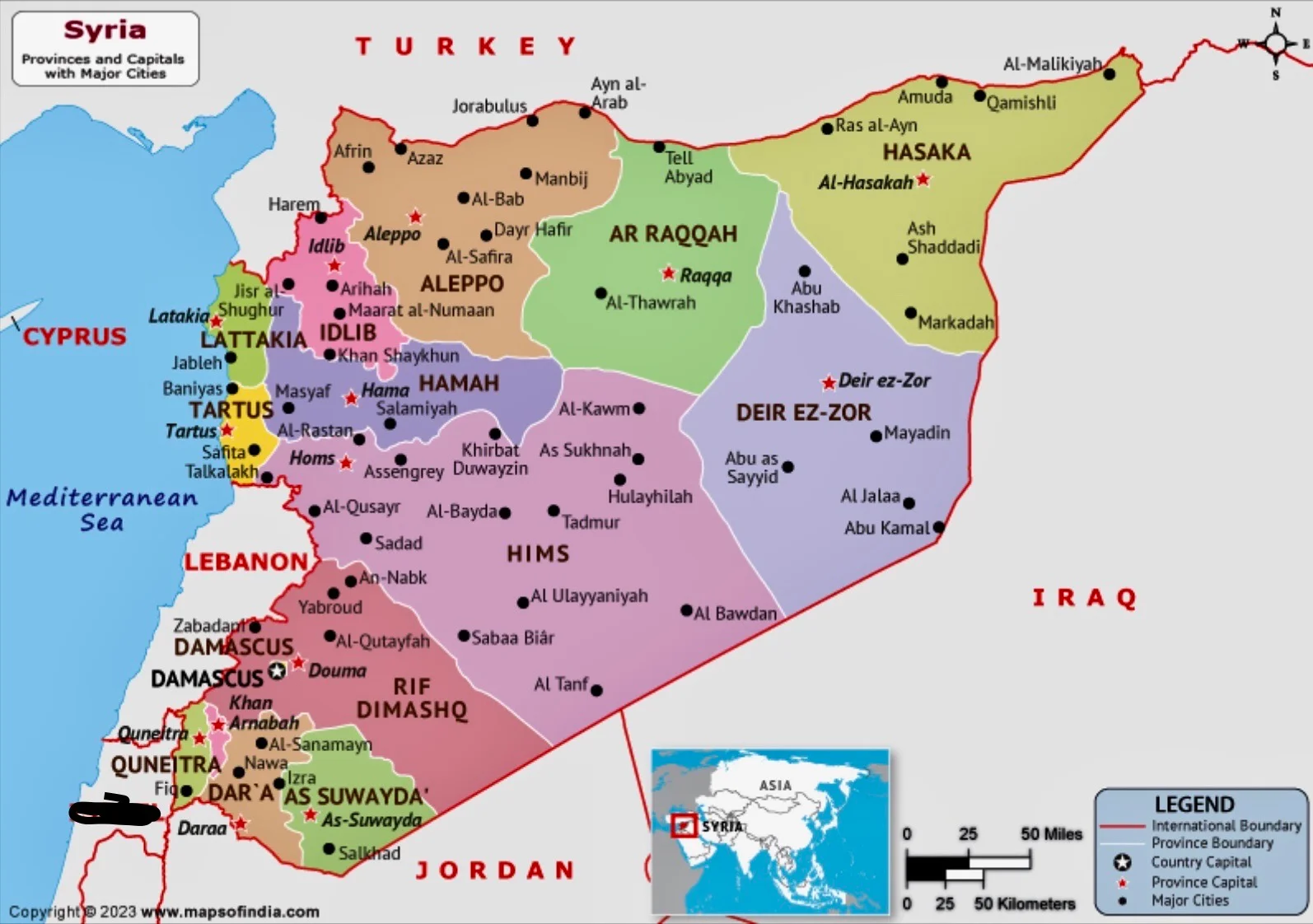
The official name is the Syrian Arab Republic.
Syria is located in the Middle East, on the western edge of Asia.
It is bordered by Turkey to the north, Iraq to the east, Jordan to the south, and Lebanon and Palestine to the southwest.
Also, to the west, Syria has a coastline along the Mediterranean Sea.
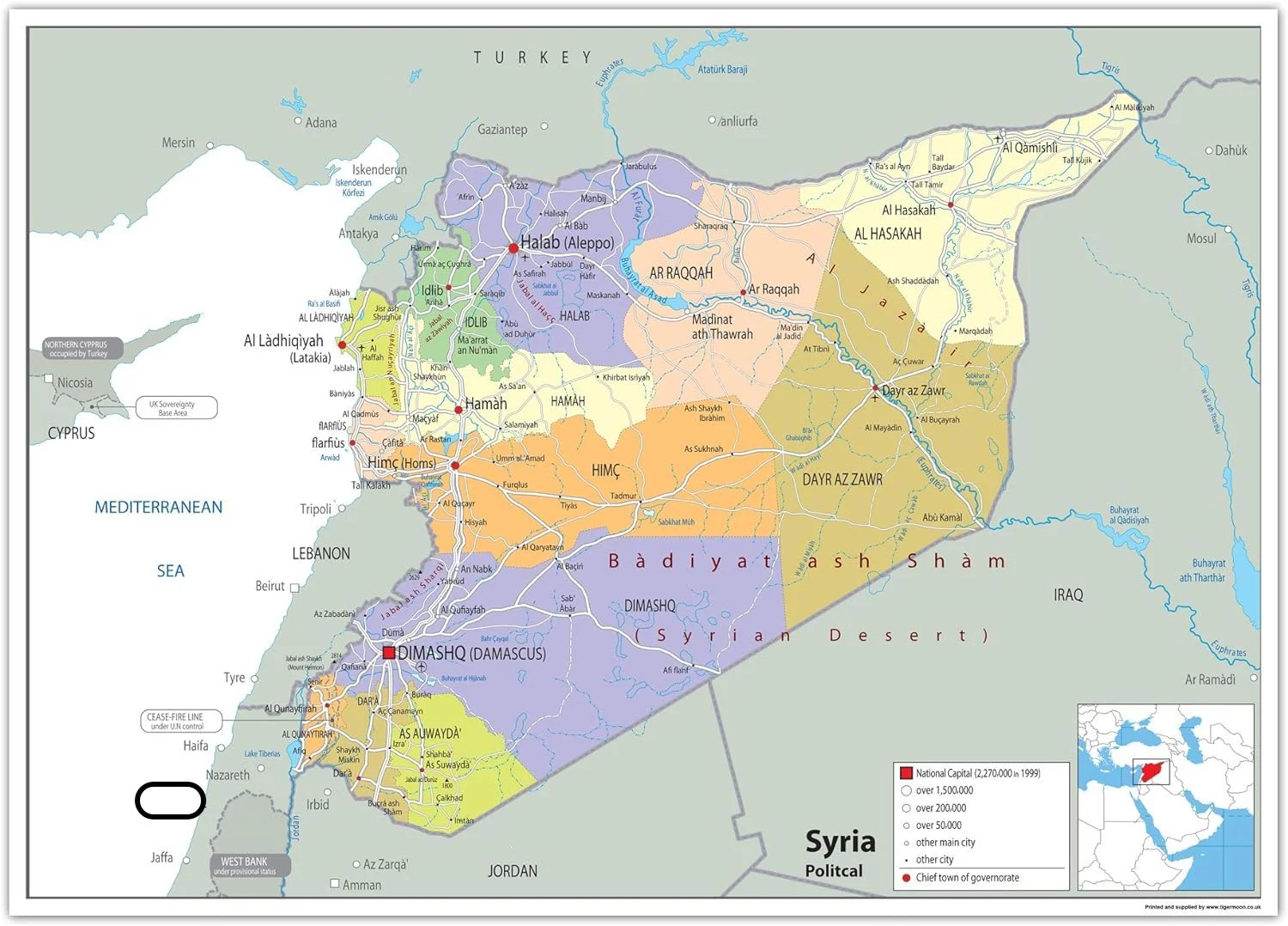
What is Syria’s capital?
Syria’s capital is Damascus, one of the oldest continuously inhabited cities in the world.
Explore Syria through the Damascus Travel Guide.
What is Syria’s population?
As of 2023, estimates show that Syria’s population is around 21 million Syrian people.
However, this number is difficult to pinpoint accurately due to the previous conflict, which has caused large-scale displacement within and outside the country.
In fact, millions of Syrians have fled as refugees, primarily to neighboring countries like Turkey, Lebanon, Jordan, and Europe.
What’s Syria’s main language?
Syria’s main language is Arabic.
Specifically, Syrian Arabic is widely spoken. Classical Arabic and Modern Standard Arabic are used in formal settings, education, and media
What is Syria’s currency?
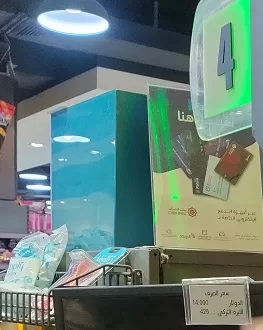
Syria’s currency is the Syrian pound, which is abbreviated as SYP.
Nowadays, after the fall of al-Assad’s regime, people and businesses have started using more stable foreign currencies to ensure economic stability.
For example, the Turkish lira, popular in northern Syria like Idlib because of Turkey’s proximity and influence, and the US dollar dominate in areas where people make everyday purchases.
This transition situation, however, will depend on the priorities and policies of the current government and the willingness of Syrians to invest their trust in a unified financial system once again.
Who are Syria’s neighbors?
Syria shares borders with the following five countries:
Turkey to the north
Iraq to the east
Jordan to the south
Palestine to the southwest
Lebanon to the west
Additionally, Syria has a coastline along the Mediterranean Sea to the west.
Check out the Entry from Iraq to Syria.
How big is Syria?
Syria has approximately 185,180 square kilometers (about 71,500 square miles), making it a medium-sized country in the Middle East.
What’s Syria’s religion?
Syria is religiously diverse, but the majority of its population practices Islam.
Additionally, about 10% of the population practices Christianity, which includes various denominations such as Greek Orthodox, Syriac Orthodox, and Maronite.
There are also small communities of Druze.
In fact, religious diversity has historically been a key feature of Syrian society.
Check out the religious celebrations here.
What are the governorates in Syria?
Syria has a total of 14 governorates (provinces).
Damascus, Aleppo, Latakia, Homs, Daraa, Tartus, Idlib, Deir el-Zor, Hasakah, Raqqa, Quneitra, Suwayda, Hama, and Rif Dimashq (Damascus Countryside).
Syria’s largest cities
Damascus
Population: Approximately 1.7 million.
It is the capital and one of the oldest continuously inhabited cities in the world.
It is the political, cultural, and economic center of Syria, known for its historical sites, such as the Umayyad Mosque, which is one of the largest and oldest mosques in the world, known for its stunning architecture and historical significance, and the Old City, which is A UNESCO World Heritage site, featuring ancient streets, souqs, and historic buildings like the Azem Palace.
Aleppo
Aleppo is one of Syria’s largest cities and a major economic center.
It is famous for its historic souks, the Citadel of Aleppo, and its rich cultural heritage.
Also, explore the Great Mosque of Aleppo, an ancient mosque famous for its impressive minaret and architectural beauty.
Homs is an important industrial city famous for its oil refineries and production.
Homs has historical significance and features notable sites such as the Crusader Castle, Khalid ibn al-Walid Mosque, and Qala’at al-Hosn.
Lattakia
It is a major port city on the Mediterranean coast and is known for its beaches also, it is a key center for trade and commerce.
Most importantly, it serves as a gateway to tourism in Syria.
Tartus is another important coastal city known for its port and historical sites.
Also, it is a center for fishing and agriculture.
Daraa, located in the south of Syria, is known for its agricultural output and historical significance.
It’s famous for its Malihi dish; you must give it a try when visiting Syria.
Deir el-Zor is an important city in eastern Syria; it is situated along the Euphrates River and has been a center for oil production.
Idlib, known as the “Green Governorate,” boasts vast green fields and a tranquil atmosphere.
The name reflects its natural beauty.
Idlib has opened its doors to visitors from around the world, offering a unique blend of ancient traditions and modern amenities.
The city boasts several shopping malls and modern facilities.
Moreover, many public spots offer free 5G internet access, ensuring that visitors can easily stay connected, something that even the capital city hasn’t implemented yet!
Raqqa
Located along the Euphrates River, the city has faced extensive destruction due to the previous conflict.
These cities have played crucial roles in Syria’s history, culture, and economy, and they continue to be significant despite the challenges.
How is the Climate in Syria?
Spring (March to May): Generally mild and pleasant, making it an ideal time for agriculture.
Summer (June to August): Hot and dry, particularly in the interior and desert regions.
Autumn (September to November): Similar to spring, with cooler temperatures and some rainfall, especially in coastal areas.
Winter (December to February): Cold, especially in the north and mountainous regions, with rainfall concentrated in the western parts
What are Syria’s natural resources?
Syria is rich in several natural resources, which include: Firstly, oil and Natural Gas: Syria has oil reserves, although production has decreased due to the previous conflict.
Natural gas is also produced and primarily used for domestic energy consumption.
Secondly, agricultural Land: The country has fertile plains, suitable for growing crops such as wheat, barley, cotton, olives, and various fruits and vegetables.
Thirdly, water resources: major rivers such as the Euphrates and the Orontes provide vital water resources for irrigation and hydropower.
These resources play a crucial role in Syria’s economy, although the previous conflict and instability in the region have severely impacted their exploitation.
Syria’s main industry
Agriculture
Agriculture is a crucial sector in Syria, employing a large portion of the population.
Major products include cereals; wheat and barley are staple crops.
On the other hand, cash crops include cotton, olives, fruits (especially citrus), and vegetables.
However, the sector has faced challenges due to displacement, water scarcity, and damage to farmland.
Luckily, after Assad’s fall, Syrians can access international markets, modern equipment, and sustainable practices, and the agricultural sector can recover.
Also, farmers may regain access to fertile lands lost during the conflict.
Textiles and Clothing
Syria has a long history in textiles, producing cotton, wool, and silk products.
The textile industry includes weaving and garment manufacturing.
If you are interested in knowing more, check out the traditional Handicrafts.
However, the industry has been affected by the loss of factories and the disruption of supply chains.
Luckily, rebuilding factories, securing raw materials, and reestablishing trade routes could revitalize Syria’s textile industry.
Improved conditions and international partnerships will drive this renewal.
Construction
Construction has been an important sector due to urban development and infrastructure projects.
Key materials include cement, steel, and bricks.
However, the construction industry has seen both destruction and opportunity, as reconstruction efforts are needed in war-torn areas.
Reconstruction will be a cornerstone of Syria’s recovery.
This sector would see massive growth as infrastructure, homes, and public facilities destroyed during the war are rebuilt, creating jobs and stimulating the economy.
Food and Beverage Processing
This sector includes the processing of agricultural products, such as canned goods, dairy products, and beverages.
Also, Syria is popular for its olive oil production.
But the industry has faced challenges due to access to raw materials and market disruptions.
The restoration of agriculture and better trade ties could lead to growth in food production and processing, improving domestic supply and creating opportunities for export.
Pharmaceuticals
Syria has a developing pharmaceutical industry that produces various medications and healthcare products.
However, access to raw materials and distribution networks has been severely affected during the previous conflict.
Nowadays, the pharmaceutical industry could regain its place by modernizing factories and ensuring access to raw materials, improving healthcare access for Syrians.
Tourism
Before the conflict, Syria was known for its rich cultural heritage and historical sites, attracting tourists to locations like Palmyra, Aleppo, and Damascus.
However, tourism has drastically declined due to safety concerns and damage to heritage sites.
Fortunately, with stability and security, Syria’s rich historical and cultural heritage could attract tourists again, revitalizing cities, and enjoying the Syrian culture.
Tourism could become a key source of foreign income.
What are Syria’s main exports?
Crude oil and petroleum products: the largest export before the conflict severely impacted production.
Textiles and clothing, including cotton products, and traditional handicrafts.
Agricultural products: including wheat, barley, cotton, olives, fruits (especially citrus), and vegetables.
Phosphate rock: A mineral used in fertilizers.
Food products: Including olive oil, spices, and processed foods.
Due to the previous conflict and sanctions, Syria’s export capacity has been significantly reduced, and the economy has faced severe challenges.
Want to Explore Syria? Embark on a journey to Syria
For more information about Syria, please get in touch with us today! Alternatively, check out our extensive range of group Syria tours.
| Share This Post!




| NEWSLETTER
Sign up and get the latest travel news monthly.